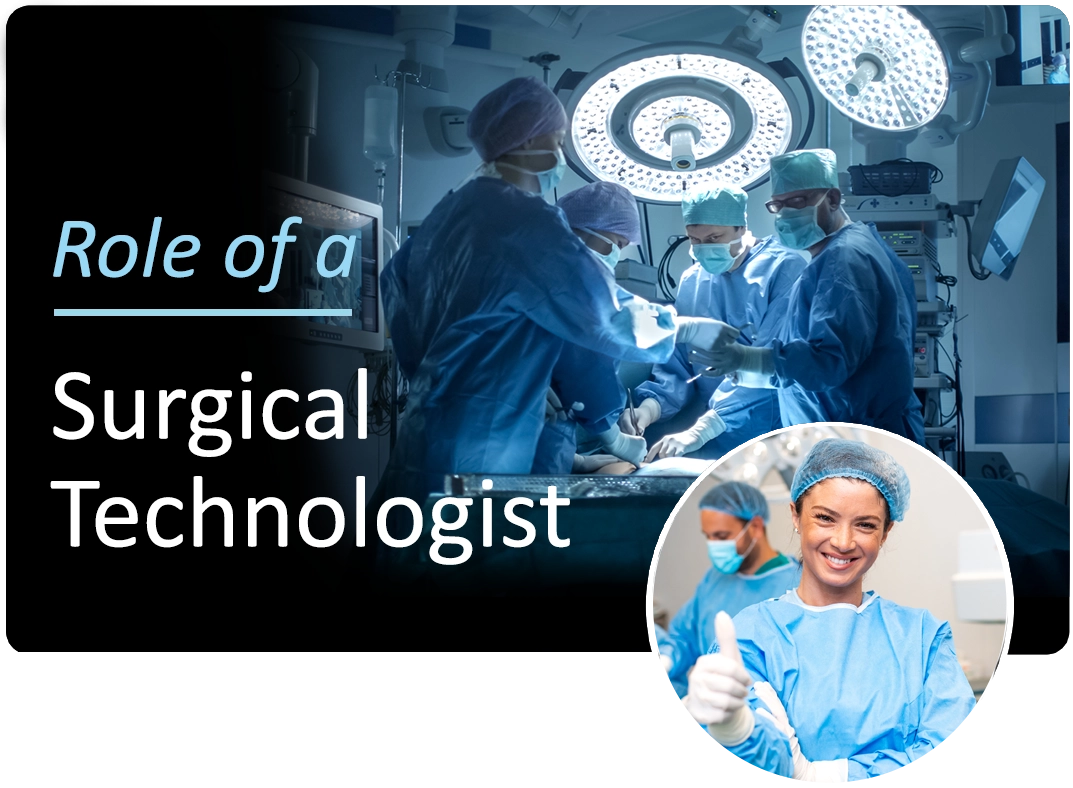






Role of a Surgical Technologist header

Surgical Technologist

Surgical Technologist careers combine hands-on technical skills with direct patient care in high-stakes environments. Surgical technologists play a critical role in ensuring safe and efficient surgical procedures by preparing operating rooms, maintaining sterile techniques, and assisting surgeons. This guide outlines clear steps to enter the surgical technologist profession from high school to employment, certification, and professional growth.

Role of a Surgical Technologist header

Step 1: High School Preparation

GOAL: Build a strong foundation in science, communication, and teamwork for surgical environments.

Recommended Courses:

  • Biology
  • Chemistry
  • Anatomy & Physiology
  • Algebra or Statistics
  • English/Communications

Actions:

  • Take the ACT and/or the SAT
  • Take advantage of AP classes if offered
  • Speak with your guidance counselor about:
    • Dual credit opportunities
    • Financial aid
    • Local college partnerships
  • Contact human resources departments at local hospitals and health care facilities to learn more about job shadow or observation opportunities and entry-level positions offered for high school students.

Resources:

  • Explore key information about a surgical technologist career including job duties, education requirements, salary, and job outlook:  Bureau of Labor Statistics (BLS) 

Step 2: Begin Working in the Field

GOAL: Gain knowledge and experience after high school or while obtaining your surgical technology education.

Job Opportunities Throughout a Surgical Technology Career Pathway

High School
Check with your local hospital or health care facilities for opportunities:
  • Shadow or volunteer
  • Entry-level positions for high school students
    • Some high school health science programs and/or hospitals may offer formal central services/sterile processing technician training
  • Summer health care camps for students
College 
After High School or while taking college courses:
  • Food Services
  • Environmental Services
  • Patient Transport
    • Some hospitals may offer specific patient transport roles in the Surgery department
  • Nursing Assistant/Patient Care Technician
    • Some hospitals may offer specific patient care tech roles in the Surgery department
  • Central Services/Sterile Processing technician
    • On-the-job training or certification available
    • Certification is not required in Kentucky, but some employers prefer formal training and/or certification

Step 3: Complete a Hospital-Based Training Program or Enroll in an Accredited Surgical Technology Program

GOAL: Select a training or education path based on availability and your needs. Requirements may vary per employer.

Option A – Hospital-Based Training Program
(if available)
  • Complete a hospital-based surgical technologist training program combining classroom instruction with hands-on clinical experience.


Option B – Accredited Surgical Technology Program
  • Complete an Associate in Applied Science (AAS) in Surgical Technology
  • Graduate from a CAAHEP-accredited program
    • Accreditation by CAAHEP (via ARC/STSA)
Photo of health care workers
Kentucky Accredited Surgical Technology Programs:
  • Kentucky Community & Technical College System (KCTCS) campuses offering Associate in Applied Science (AAS) in Surgical Technology degrees:
    • Ashland Community and Technical College (Ashland)
    • Bluegrass Community and Technical College (Lexington)
    • Hazard Community and Technical College (Hazard)
    • Hopkinsville Community College (Hopkinsville)
    • Jefferson Community and Technical College (Louisville)
    • Madisonville Community College (Madisonville)
    • Owensboro Community and Technical College (Owensboro)
    • Somerset Community College (Somerset)
    • Southcentral Kentucky Community and Technical College (Bowling Green)
    • Southeast Kentucky Community and Technical College (Cumberland)
    • West Kentucky Community and Technical College (Paducah)
  • Sullivan University (Louisville)

Surgical Technologist Training Programs

Search for college programs in Imaging near you.

Filter By:

Steps 4 and 5: Start Career and Obtain Certification

Hospital-Based Training Path

Step 4: Start Your Career as a Surgical Technologist
Examples of Employment Settings

  • Hospital Operating Room
  • Labor & Delivery
  • Outpatient Surgery Centers
  • Specialty Surgical Practices

Step 5: Obtain National Certification
(eligible after three years of experience)
  • Tech in Surgery – Certified (TS-C)
    • Obtained through National Center for Competency Testing (NCCT)

Accredited Education Path

Step 4: Obtain National Certification
(generally required by most employers)
  • Certified Surgical Technologist (CST)
    • Obtained through the National Board of Surgical Technology and Surgical Assisting (NBSTSA)

Step 5: Start Your Career as a Surgical Technologist

Examples of Employment Settings

  • Hospital Operating Room
  • Labor & Delivery
  • Outpatient Surgery Centers
  • Specialty Surgical Practices
illustration of patient chart

Resources:

  • Find NCCT eligibility details, an exam application, and continuing education requirements:
    https://www.ncctinc.com
  • Find NBSTSA eligibility details, an exam application, and continuing education requirements:
    https://www.nbstsa.org

Kentucky Practice Note:

  • Kentucky does not require licensure for surgical technologists
  • Employers may require or prefer one certification over another 

Hospital Career Search

Visit the Kentucky Hospital Job Center
Search for current positions open at Kentucky hospitals, leading to exceptional careers

Step 6: Pursue Professional Growth and Continuing Education

GOAL: Continue professional growth and expand career opportunities.

Continuing Education (CE)
  • Required annually to maintain TS-C certification
  • Required every two (2) years to maintain CST certification

Professional Organizations

Optional: Pathways for Advancement
  • Specialization (e.g., orthopedics, cardiovascular, neuro)
  • Lead surgical technologist or preceptor roles
  • Transition into surgical assisting or leadership


illustration of surgical tools

Career Path From Classroom to Operating Room:

Surgical Technologist

Step 1: High School Preparation

  1. Take college preparatory courses
  2. Take the ACT and/or SAT
  3. Speak with your guidance counselor
  4. Contact HR at hospitals to job shadow

Step 2: Begin Working in Field

Surgery Orderly/Patient Transporter, Central Services/Sterile Processing Technician or Entry Level Roles

Step 3: Hospital-Based Training and/or Accredited Surgical Technology Program

Option A: Complete Hospital-based Training Program (if available)

Option B: Enroll in an Accredited Surgical Technology Program

Step 4: Start career as a Surgical Technologist

Settings after training

  • Hospital Main Surgery Department
  • Hospital Labor and Delivery Department
  • Outpatient Surgical Centers
  • Specialty Surgical Practices

Step 5: Obtain National Certification (eligible after 3 years of experience)

Tech in Surgery – Certified (TS-C) obtained through the National Center for Competency Testing (NCCT)

Option B: Enroll in an Accredited Surgical Technology Program

Step 4: Obtain National Certification (generally required by Kentucky employers)

Certified Surgical Tech (CST) obtained through the National Board of Surgical Technology and Surgical Assisting (NBSTSA)

Step 5: Start career as a Surgical Technologist

  • Hospital Main Surgery Department
  • Hospital Labor and Delivery Department
  • Outpatient Surgical Centers
  • Specialty Surgical Practices

Step 6: Professional Growth & Engagement

Advanced Roles may include, but not limited to:
  • Specialization
    • Orthopedics
    • Cardiovascular
    • Neuro
  • Preceptor or Education Roles
  • Surgical First Assistant
  • Leadership Roles
  • Maintain Continuing Education (CE) credits
  • Get involved in Professional Organizations
    • Association of Surgical Technologists (AST)
    • Kentucky State Assembly of AST